
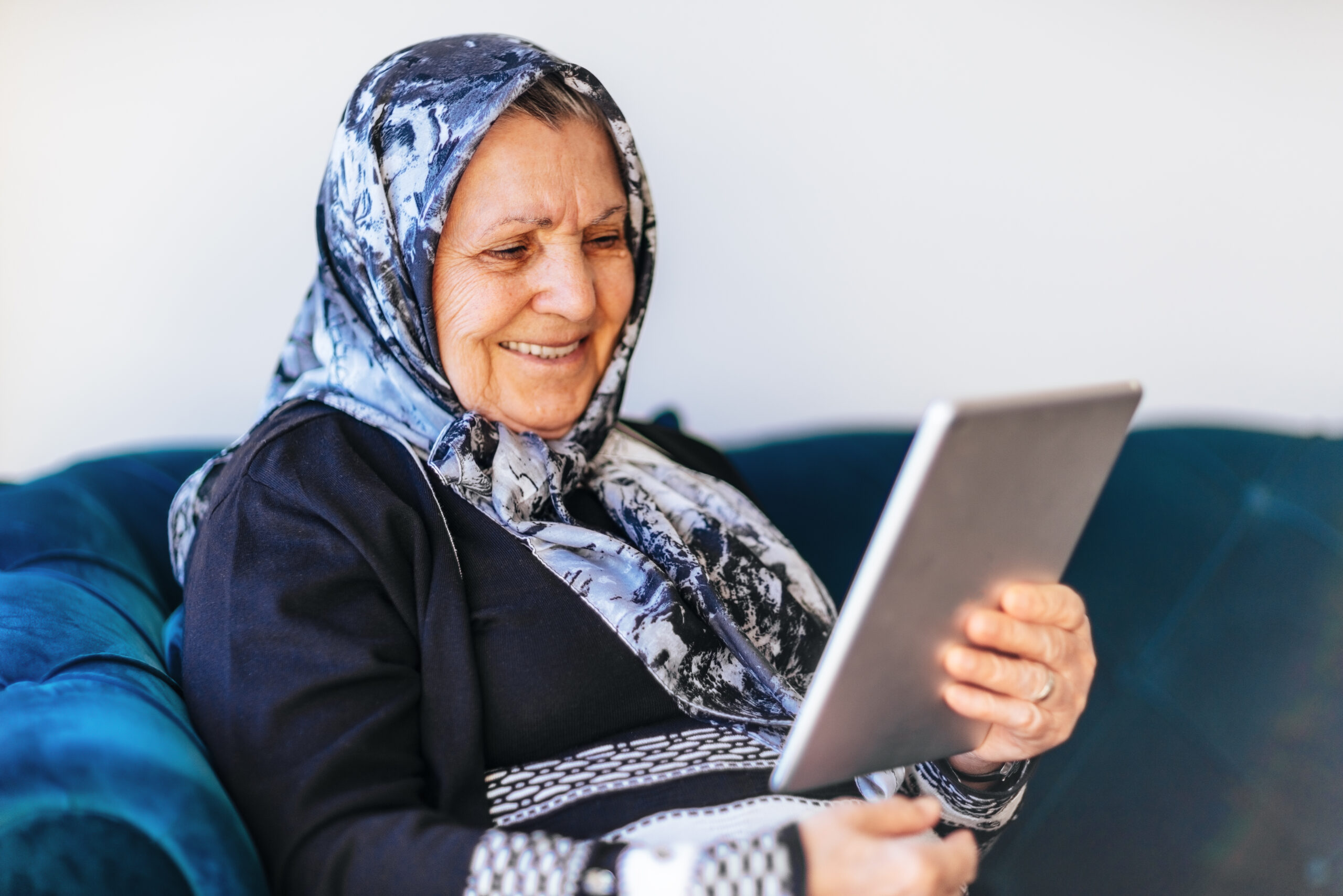
Accessible, pre-programmed tablets designed to support people living with dementia with activities of daily living, including medication management, mealtimes, reminders and socialization.
Who could benefit from reading this?
- People living with dementia, their care partners, and staff at community agencies that provide services to people living with dementia.
Review the Before you begin section for foundational knowledge that will be helpful for any dementia community initiative.
Key information
Who is this project for? People living with dementia, their care partners, and staff at community agencies that provide services to people living with dementia.
Project Lead: Human Endeavour
Project partners: The Regional Municipality of York, Community & Home Assistance to Seniors (CHATS), Senior Persons Living Connected, Punjabi Community Health Services (and PCHS Calgary), York University, The United Way of Greater Toronto, Alzheimer Society of Calgary, Centre of Newcomers (Calgary), South Asian Senior Support Society (Calgary)
Project status: complete, 2023-2025
Get in touch:
Project story
Background:
Developed with input from healthcare providers, community partners, care partners, and seniors, Tech-empowered Healthy Living for Seniors with Dementia (TEHL) promotes independent and safe living in community settings through assistive technology. The program provides seniors living with dementia with an Android tablet that is programmed to respond to voice commands, offer information, and sends important reminders about routine activities of daily living, such as meals and medications. The tablet has 15 preprogrammed languages, including immigrant languages commonly spoken in Canada. The tablets also notify care partners by email when selected tasks are not completed, with the potential for them to provide additional support. Training for use of the tablets was provided to healthcare workers of partner organizations, while illustrative manuals were provided for people living with dementia and their care partners, in addition to a remote telephone helpline for real-time assistance.
Through a community-academic partnership, York University conducted a comprehensive impact evaluation to assess the efficacy of the technology and its influence on the well-being of seniors and their care partners. Collaborating with 13 senior-serving organizations across Ontario and Alberta, the project gathered real-time, on-the-ground feedback that directly shaped product enhancements. The vital prompts and interaction between the tablet, the person living with dementia, and their care partner supports better nutrition, medication intake, socialization and recreation, sleep improvement, and risk mitigation for the health and safety concerns of seniors living with dementia aging in place.
Goals:
✅To improve the quality of life and well-being of people living with early-to-moderate-stage dementia and their care partners through a first-of-its-kind customized assistive technology solution, with related training and support.
✅To carry out intervention research (also called an impact evaluation study) to measure the effectiveness of the technology and its impact on the lives of seniors living with dementia and their care partners throughout the duration of the project to enhance and scale the project’s offerings.
✅To share findings from this intervention on how to reach and successfully engage seniors living with dementia and their care partners with this technology.
Milestones and achievements:
Key Successes of the TEHL Project
- First-of-its-kind, culturally inclusive assistive technology.
- Improved independence and safety for seniors living with dementia.
- Empowerment and support for care partners.
- Equitable reach across urban, rural, and remote communities.
- Strong partnerships and collaborative implementation.
- Early evidence of positive impact.
- Sustainability and innovation for the future.
Impact
Project findings:
Seniors
A majority of seniors strongly agreed or agreed that the tablet had a positive impact:
- 81% said it helped them remember to complete daily tasks.
- 79% felt it met their needs.
- 67% found it easy to use.
Below are results for five key indicators identified by the Public Health Agency of Canada. Percentages show the proportion of seniors who “strongly agreed” or “agreed” using a Likert scale.
- Indicator 1: 64% increased technology knowledge and skills
- Indicator 2: 87% improved health behaviours (e.g. on time medication)
- Indicator 3: 80 % Improved protective factors (e.g. feeling secure)
- Indicator 4: Improved well-being (cognitive 83%, emotional 74%, social 80%)
- Indicator 5: Improved quality of life (from the care partners perspective)
Care partners
- 60% strongly agreed or agreed that their own quality of life has improved by having the tablet.
- 51% strongly agreed or agreed that the tablet lessens their stress and care responsibilities.
- Improved peace of mind and reduced stress.
- Enhanced ability of care partners to provide timely support.
Organizations and sector
- 100% of the managers who participated in the study and their team members either strongly agreed or agreed that they could identify benefits to their organization of having the TEHL tablets.
- Managers appreciated that the TEHL tablets are provided free of charge to participating seniors.
- Strengthened capacity among healthcare workers and care partners.
- Evidence that the multilingual and customizable features of the tablets make the solution equitable and inclusive for immigrant communities in Canada.
- The tablet’s ability to verbally communicate with seniors in one of the 15 supported languages was seen by managers as an important feature.
Want to know more? Download the full research report here
Experiences:
“Yeah, the dementia tablet is very good for me, it is helpful for me…I am very thankful to you for this. I have a memory problem so lot of things I forget in my practical life especially I forget my medicines; time of the medicine and I forget eating and lot of things this tablet reminds me…also, it helps with entertainment so when I am sad…It is very good also because the tablet gives reminders to me in my own language Urdu…” -senior.
“Care partners have reported that the senior’s mood is better since receiving the tablets. They have increased independence with the tablets.” -manager
“As we all know helping a senior or having parents with dementia is not easy and if somebody’s working, I’m working full time and I’m taking care of my father and I, of course I have my own family. So this [tablet] is like a good hand to help me. Yeah, it’s a helpful device.” – care partner
Insights
Lessons learned:
- Seniors: Seniors were especially pleased to be seen as an important member of the research team, and they willingly shared their recommendations. Senior emphasized the importance of the games on the tablet, as an opportunity to experience joy and growth. One senior recommended that organizations hold a follow-up session a month after a senior receives their tablet to assess needs and preferences.
- Care partners: Several care partners suggested giving the tablets to seniors early in their dementia journey. Suggesting chat and video calling applications on the tablet would be beneficial for seniors to be more engaged with family and friends. Recommended in-person training sessions if possible, as training would not have been as positive if it had been conducted online.
- Managers: Managers felt that additional training would be beneficial. Managers recommended that reminders on the tablets be introduced gradually for seniors who are less experienced with technology. Managers recommended that organizations offer programs in a hybrid format so that seniors have the option to participate using the tablets.
- General: Managers, care partners, and seniors all spoke positively about the ability to receive support and troubleshooting for technical issues, stating it is an essential part of the program. It is recommended that during intake the senior and their care partner be given an opportunity to introduce themselves in detail. The data highlighted the importance of recognizing the individuality of people living with dementia and understanding their familiarity with technology.
Recommended resources:
- Download the full research report
- TEHL Project Evaluation Report
Production of this project has been made possible through funding from the Public Health Agency of Canada (PHAC). The views expressed herein do not necessarily represent the view of the Public Health Agency of Canada.