
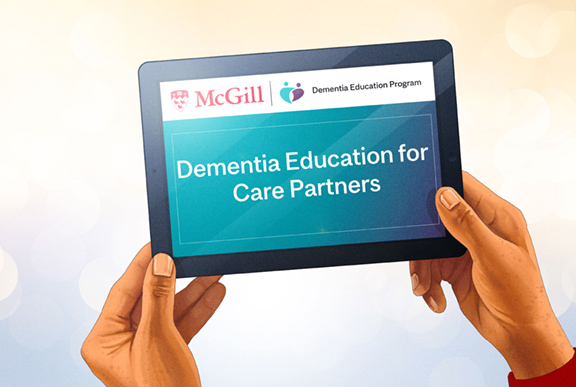
This project comprises the development of the bilingual Dementia Education For Care Partners online education program. Through 10 interactive online modules with embedded real life scenarios, the program follows participants through their learning journey over 10 weeks. It analyses the evolution of their dementia knowledge and confidence, selfcare skills, and includes self-evaluations of preparedness for the next stages of dementia for the person they are caring for.
Who could benefit from reading this?
- Review the Background section for foundational knowledge that will be helpful for any dementia community initiative.
- Care partners (family/friend) of people living with dementia.
- Individuals and organizations interested in using the lessons learned and recommended resources to create or modify a similar program.
Review the Before you begin section for foundational knowledge that will be helpful for any dementia community initiative.
Key information
Who is this project for? This project is intended for informal care partners of people living with dementia in Quebec, including Montreal and remote communities in rural parts of the province. This initiative is the outcome of the TOTAL eLearning Research Project funded by the Public Health Agency of Canada (PHAC) to raise awareness of dementia and promote dementia-inclusive communities.
Project Lead: McGill University
Project partners: The McGill Dementia Education Program; the Steinberg Centre for Simulation and Interactive Learning (SCSIL) and the Office of Education Technology and E-Learning Collaboration for Health (Ed-TECH) for the Faculty of Medicine and Health Sciences (FMHS) at McGill University.
Project status: complete, 2021-2023
Get in touch:
Project story
Background:
Our project consists of two major studies: a needs assessment and a pilot study. For the needs assessment, we were able to survey 81 participants who are care partners of people living with dementia in Quebec to better understand their needs for their caregiving journey.
For the pilot study, the team worked with subject matter experts and people with lived experience to develop 10 online modules that educate the care partners of people living with dementia on their caregiving journey. The modules were delivered to the participating care partners of people living with dementia in Quebec over the span of 10 weeks.
The pilot study involved launching the ten modules online to be available to 30 participants, and subsequent questionnaires and focus groups showed that the participants found the program to be informative and helpful.
What was then titled Ten Online Modules over Ten Weeks for Adult Learners (TOTAL) eLearning for Family/Friend Caregivers of Persons Living with Dementia eLearning course is now referred to as Dementia Education for Care Partners.
Goals:
- Expedite the creation of an online curriculum in dementia education and infrastructure for virtual support community.
- Deliver TOTAL eLearning including to remote regions and technologically marginalized populations.
- Evaluate TOTAL eLearning.
- Create a virtual support community for caregivers of people living with dementia.
- Build partnerships to adapt TOTAL eLearning to diverse contexts.
Milestones and achievements:
✅Participants found the program to be informative, and that it has helped them to communicate with the person living with dementia they are caring for as well as with the formal and informal care personnel.
✅Participants reported feeling reassured and validated, as they better understood their caregiving journey and got a better sense that the challenges they are experiencing are real.
✅The TOTAL eLearning modules were made available to the general public in April 2024.
Impact
Project findings:
Care partners had high levels of satisfaction with the TOTAL eLearning modules
⬆️Knowledge and skills (better understanding, help me to act, do something differently, discuss with others)
⬆️Protective factors (allows me to validate my actions)
⬆️Wellbeing (prevent and handle problems, prepared for discussion)
More resources through the Dementia Education Program, click here
Insights
Lessons learned:
- The results from the Information Assessment Method (IAM) (Granikov et al., 2020) used to confirm the relevance of the information in the course, the impact of the information on cognition, potential use of the information, and subsequent health outcomes, helped to inform next iterations of the online modules to maximize the benefit for care partners.
- Through our preliminary analysis, we were able to identify 18 major themes: accessibility of the learning management system; feedback on scenarios; feedback on content; feedback on synchronous sessions and virtual community; time commitment for participation; emotional load of the experience; psychological benefit of the experience; need for connection with other participants; exchanging caregiving approaches through participation; participants coming together to make recommendations; current challenges with the system; challenging cases of dementia; overall feedback on the whole program; future recommendations recommending the program to others; continuous access to the course; caregiving stories; and feelings around the care partner role.
- Reaching diverse communities proved to be our biggest challenge. This challenge is also shared by other groups in the CDLRN and this is why we took part in the rural communities working group. We are currently trying to implement different recruitment approaches and techniques in order to obtain a more diverse population of participants.
This project is funded by the Public Health Agency of Canada under the Dementia Community Investment (DCI).